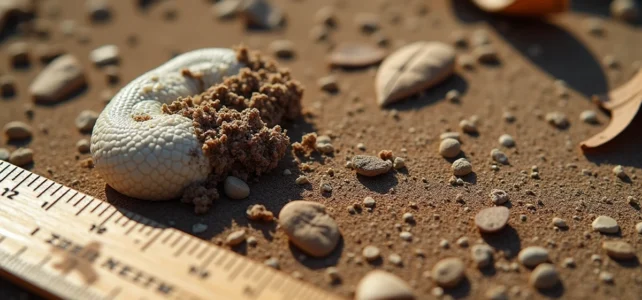
You discover a small brownish pile near a low wall or under a hedge, and you hesitate: rodent, bird, or snake? Snake droppings have a very particular structure, but their appearance varies depending on the species, diet, and even the season. Learning to recognize them allows you to confirm the presence of a grass snake or viper in a garden without needing to encounter the animal.
Feces and urates mixed: the typical structure of snake droppings
Unlike mammals, snakes expel their digestive and urinary waste all at once. The result is a mass where two distinct components coexist: a dark part (the feces) and a whitish or chalky part (the urates, equivalent to solid urine).
In many lizards, these two elements remain well separated. A dark cylinder is observed, ending with a white tip that is easily identifiable. In snakes, feces and urates are strongly mixed into a more homogeneous mass. This nuance is valuable when distinguishing between lizard droppings and those of a grass snake, especially in photographs.
By consulting resources dedicated to photos and identification of snake droppings, you will notice that most images show this characteristic mixture, sometimes accompanied by a slight liquid film around it.
Texture, color, and size: visual criteria for identifying snake droppings
Have you ever observed the texture of a dropping found in the garden? This detail strongly guides identification.
Consistency and color
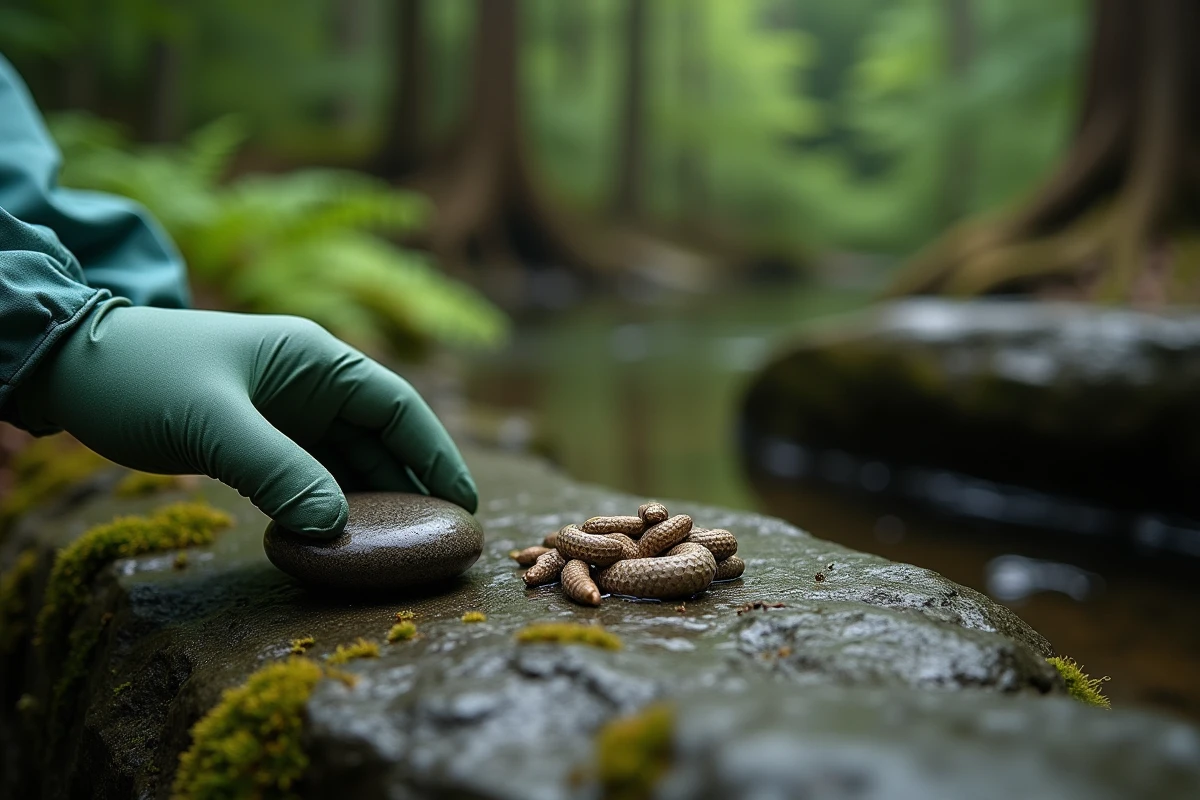
When fresh, snake droppings have a soft, almost pasty consistency. The fecal part is dark brown to black. The urate fraction is white to yellowish, sometimes granular.
As they dry, the whole hardens and the distinction between the two components becomes less clear. The dropping can then resemble a small gray-brown lump, which complicates differentiation from bird droppings.
Shape and dimensions
No regular cylindrical shape like that of a rodent. Snake droppings are often irregular, slightly elongated, without pointed ends. Their size directly depends on that of the animal: an adult collar grass snake produces droppings that are significantly larger than those of a smooth snake.
- A dropping from a small grass snake measures a few centimeters long, comparable to a dropping from a large lizard, but with the characteristic feces-urates mixture.
- The droppings of larger grass snakes can reach the size of a small mammal’s droppings, which often causes confusion with a rat or a polecat.
- The smell is generally strong and musky, different from the acrid and ammonia-like smell of bird droppings.
Snake droppings during fasting or shedding: a deceptive appearance
A snake does not eat every day. During prolonged fasting phases (before shedding, during breeding, or in times of stress), the digestive tract processes little food material.
The result is a excretion composed almost solely of very dry and crumbly white urates, with little or no dark part. Reptile owners in terraristics are well aware of this phenomenon, but it regularly surprises beginners who think it is an anomaly.
In a garden, finding a small white-chalky deposit without a brown component can therefore indicate the passage of a snake during a fasting period. This is not a sign of illness, but a normal metabolic function.
Do not confuse: snake, lizard, bird, or rodent
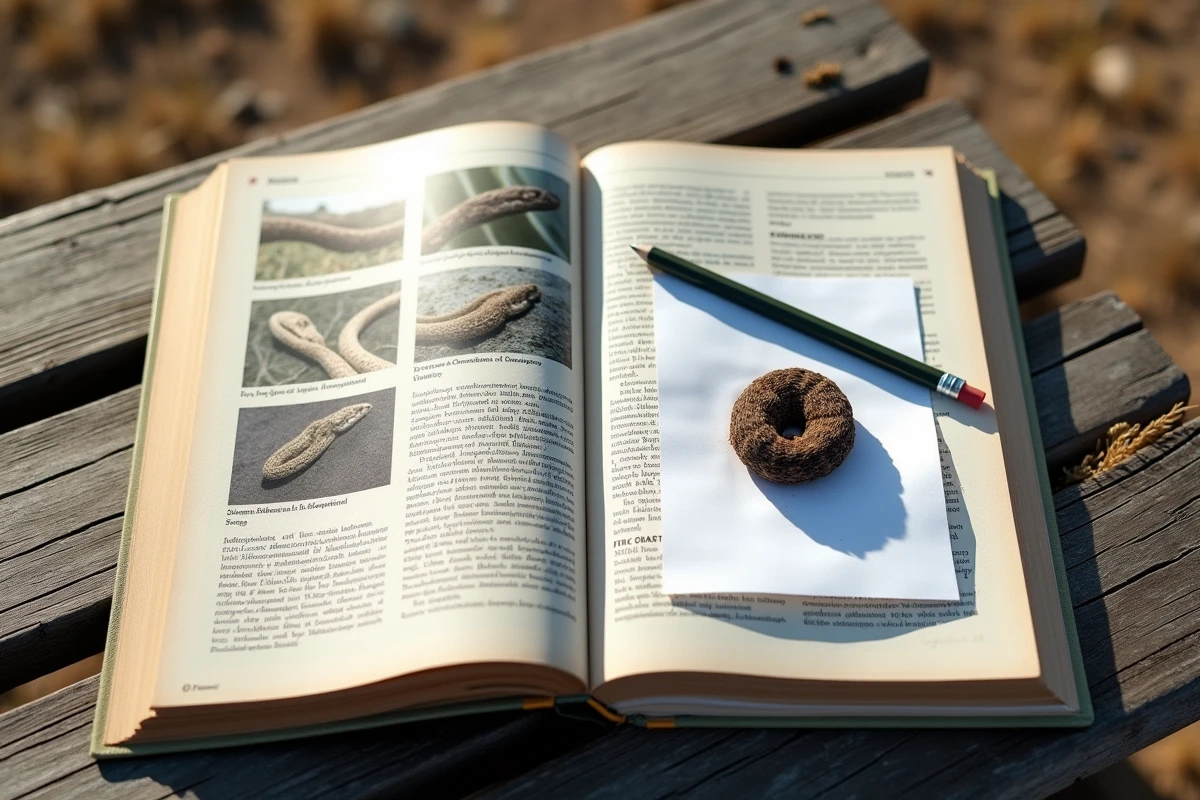
The most frequent confusion concerns bird droppings. Both contain a white fraction (urates in snakes, uric acid in birds). Two clues help to decide.
- Bird droppings are projected, often splattered on a vertical surface or hard ground. Snake droppings are deposited on the ground, in a compact pile.
- Rodent droppings (rat, mouse) are cylindrical with pointed ends and never contain an integrated white fraction.
- Lizard droppings have a white tip clearly separated from the dark cylinder, whereas in snakes the two components are fused.
- Hedgehog droppings, often found in the same garden areas, are black, shiny, and contain visible insect fragments (elytra, legs).
Where and when to find snake droppings in the garden
Snakes defecate at intervals of several days to several weeks, usually shortly after a meal. Finding a snake dropping is therefore a one-time event, not a sign of infestation.
The most likely places are thermoregulation areas: flat stones exposed to the sun, edges of low walls, wood piles, open compost. Grass snakes also favor the edges of water bodies, where they hunt amphibians and small fish.
A single dropping found in spring or summer confirms the presence of a snake in the area, but does not indicate whether it lives there permanently. To assess regular presence, other signs must be observed: shed skins, tracks in low vegetation, or direct sightings during warm hours.
The identification of a snake dropping relies on three verifiable elements without equipment: the feces-urates mixture in a homogeneous mass, the absence of regular cylindrical shape, and the location on the ground in a sheltered area. By cross-referencing these criteria with the season and type of garden, confusion with other animals becomes unlikely.