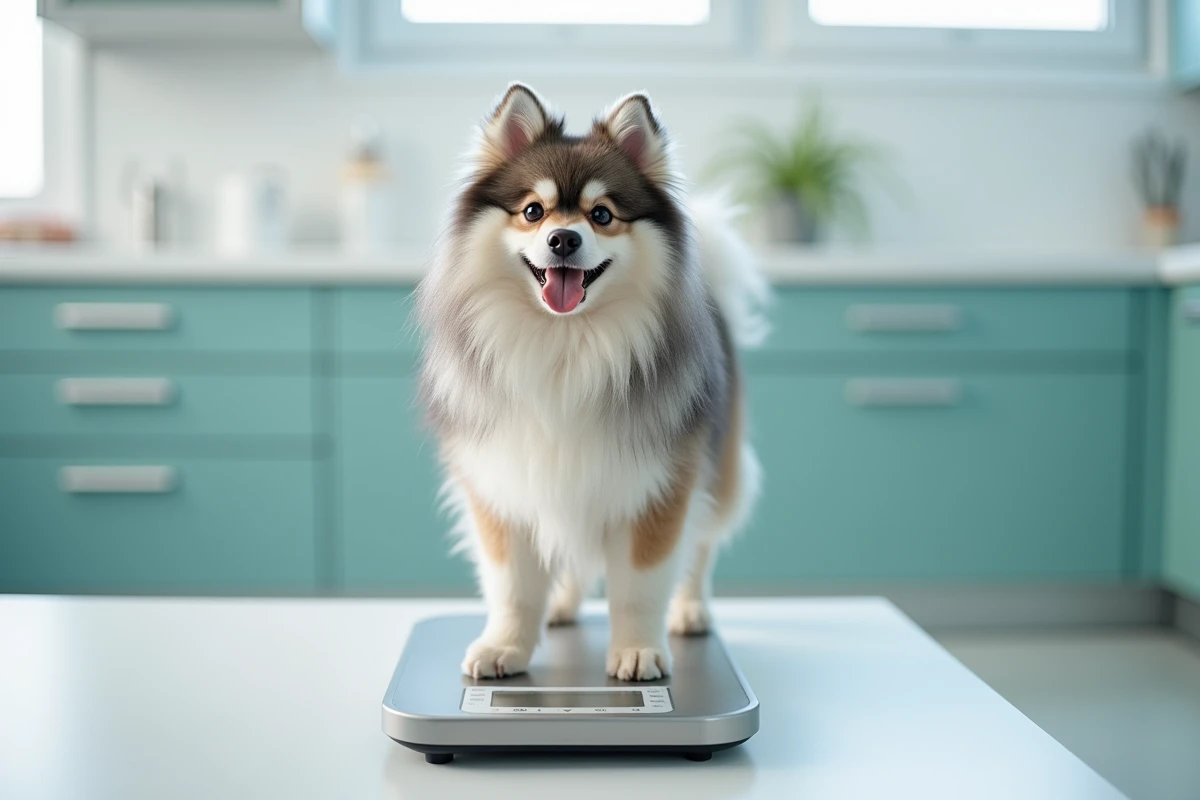
The Pomsky remains a hybrid without an FCI standard, which makes any estimate of adult weight more complex than for a stabilized breed. The official range published by the FBKC goes from 2 to 20 kg for adult weight, with a height at the withers between 20 and 50 cm. This range reflects a genetic instability that simplified charts often obscure.
Generation F1, F2, F3: the direct impact on the adult size of the Pomsky
The generation number is the first predictive factor of adult weight. An F1 Pomsky (direct cross between Siberian Husky and Pomeranian) produces the greatest variability: in the same litter, some puppies will finish their growth below 7 kg, while others will exceed 15 kg. We observe that F2 and F3 lines tend to reduce this gap, without eliminating it.
French breeders now segment their litters into commercial categories that serve as benchmarks, but we recommend taking these with a grain of salt. Tracking the weight of the Pomsky on 4 Pattes d’Amour illustrates this variability according to generations and announced sizes.
- Pomsky Toy: about 26 to 34 cm at adult withers, with weight estimates around 4 kg for some litters announced by breeders
- Pomsky Mini: intermediate size reported between 6 and 8 kg adult according to breeding announcements
- Pomsky Standard: around 40 to 45 cm at the withers, with F3/F3b litters announced between 14 and 17 kg adult
These figures come from breeder estimates, not validated population data. The distinction between toy/mini/standard is not regulated by any official kennel organization.

Growth curve of the Pomsky: critical phases and end of development
The Pomsky reaches its weight maturity earlier than a Siberian Husky, but later than a Pomeranian. We place the end of growth around 13 months for the majority of subjects, with variations depending on the size.
Rapid growth between 2 and 6 months
This is the phase where the puppy gains the most mass proportionally. A male Pomsky can double or even triple its weight between the second and fifth month. Females follow a similar trend with a slightly lower size based on data collected by tracking platforms: adult size between 20 and 35 cm for females compared to 25 to 40 cm for males.
Progressive plateau from 7 to 13 months
The rate of weight gain slows significantly. A puppy that continues to gain weight rapidly after 9 months is likely to exceed the size announced by the breeder. At this stage, the weight generally represents more than 80% of the final adult weight. We recommend bi-monthly weigh-ins to detect any drift from the expected curve.
Feeding and ration of the growing Pomsky: adjust without guessing
The amount of kibble for a Pomsky cannot be based on feeding tables designed for breeds of comparable size. A 10 kg Pomsky does not have the same metabolic needs as a 10 kg Cavalier King Charles, because its body composition (muscle/fat ratio, bone density) differs.
The ration should be recalculated every month during the first year. An adult toy Pomsky of 4 kg will not have the same caloric intake as a standard of 15 kg. Premium kibble manufacturers offer “small size” or “medium size” ranges, but the choice between the two depends on the actual size of the puppy, not its commercial designation.
- Weigh the puppy on an empty stomach, always at the same time of day, to obtain comparable data
- Compare the measured weight to the range of the announced category (toy, mini, standard) and adjust the ration if the difference exceeds 10%
- Prefer a food with a protein level suitable for growth, avoiding excess calcium that disrupts joint development in small sizes

Warning signs: overweight and underweight in the adult Pomsky
The absence of an official standard complicates the assessment of body condition. The Body Condition Score remains the most reliable tool, regardless of the weight displayed on the scale. A standard Pomsky of 16 kg can be in perfect condition, while a toy of 5 kg may already be overweight.
The dense coat inherited from the Husky easily conceals excess fat. We recommend regularly palpating the ribs: they should be noticeable under a thin layer of tissue without being visible. The waist should remain defined when viewed from above.
Underweight: do not confuse toy size with thinness
A legitimate toy Pomsky has a fine bone structure but proportionate musculature. A thin puppy, on the other hand, shows prominent vertebral processes and a pronounced abdominal hollow. The difference is seen in muscle tone, not in the number on the scale.
Overweight: increased risk in toy lines
Small-sized Pomskys carry proportionally more weight on their joints. A few hundred grams too much is enough to accelerate cartilage wear. The life expectancy of the Pomsky is estimated between 12 and 15 years, and maintaining an optimal weight remains the most direct lever to preserve this longevity.
The genetic variability of the Pomsky makes each subject unique. The toy, mini, and standard categories provide a framework for understanding, but only regular weight tracking correlated with body assessment allows for reliable management of growth and nutrition.