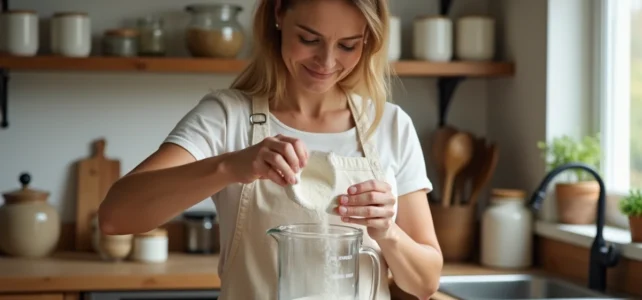
Converting grams to liters in cooking means transitioning from a unit of mass to a unit of volume. These two measurements do not quantify the same thing, and no universal rule allows them to be interchanged without an additional piece of information: the density of the ingredient. This distinction explains why simplified conversion tables often miss the mark as soon as we move away from water or milk.
Ingredient Density: The Factor That Tables Overlook
Density (or specific weight) expresses how much a liter of a given substance weighs. For water at room temperature, one liter weighs about one kilogram. The conversion formula is straightforward: volume in liters = mass in grams divided by density in grams per liter.
The problem arises with other ingredients. Flour, for example, is significantly lighter than water at equal volume. One liter of flour weighs much less than one liter of milk. Conversely, honey or maple syrup are denser than water: the same weight occupies a smaller volume.
When a recipe calls for a weight in grams and the only available tool is a measuring cup graduated in liters or centiliters, converting without considering density skews the measurement. This is the most common source of error in everyday cooking. To delve deeper into gram to liter conversion with La Cuisine de Watoote, the reasoning remains the same: each ingredient has its own density, and taking it into account changes the result.

Converting Grams to Liters for Common Liquids
Liquids are the easiest to convert because their density varies little from one product to another, at least for aqueous liquids. Water, broth, and vinegar have a density very close to one kilogram per liter. This means that for these liquids, the grams-milliliters correspondence is almost direct.
Whole milk is slightly denser than water, but the difference remains negligible in most savory or sweet recipes. However, as soon as a liquid contains a lot of sugar or fat, the density changes noticeably.
Honey and Syrups Case
Honey is significantly heavier than water at equal volume. A given volume of honey therefore weighs more than the same volume of water. If a recipe specifies a weight of honey and the measurement is done with a measuring cup, you need to pour less volume than you would for water.
Sugar syrups follow the same logic. The higher the sugar concentration, the more the density deviates from that of water. The only reliable workaround remains the scale, or a small test before multiplying the proportions.
Converting Grams to Liters for Powders and Solids
This is where generic tables become quite misleading. Powders (flour, powdered sugar, cocoa, starch) have very variable densities, and this density changes depending on how they are packed.
- Packed wheat flour in a measuring cup occupies less volume than the same flour poured in a sprinkle, for the same weight. The way the container is filled alters the result.
- Powdered sugar is denser than flour: the same volume of sugar weighs more than the same volume of flour. Swapping the two in a single table produces significant discrepancies in baking.
- Cocoa powder, cornstarch, and almond powder each have their own density, sometimes very different from each other.
No single table adequately covers all powders. The best approach is to look up the specific density of the ingredient in question, then apply the formula: weight divided by density = volume.
Centiliters Rather Than Liters: The Practical Unit in French Cooking
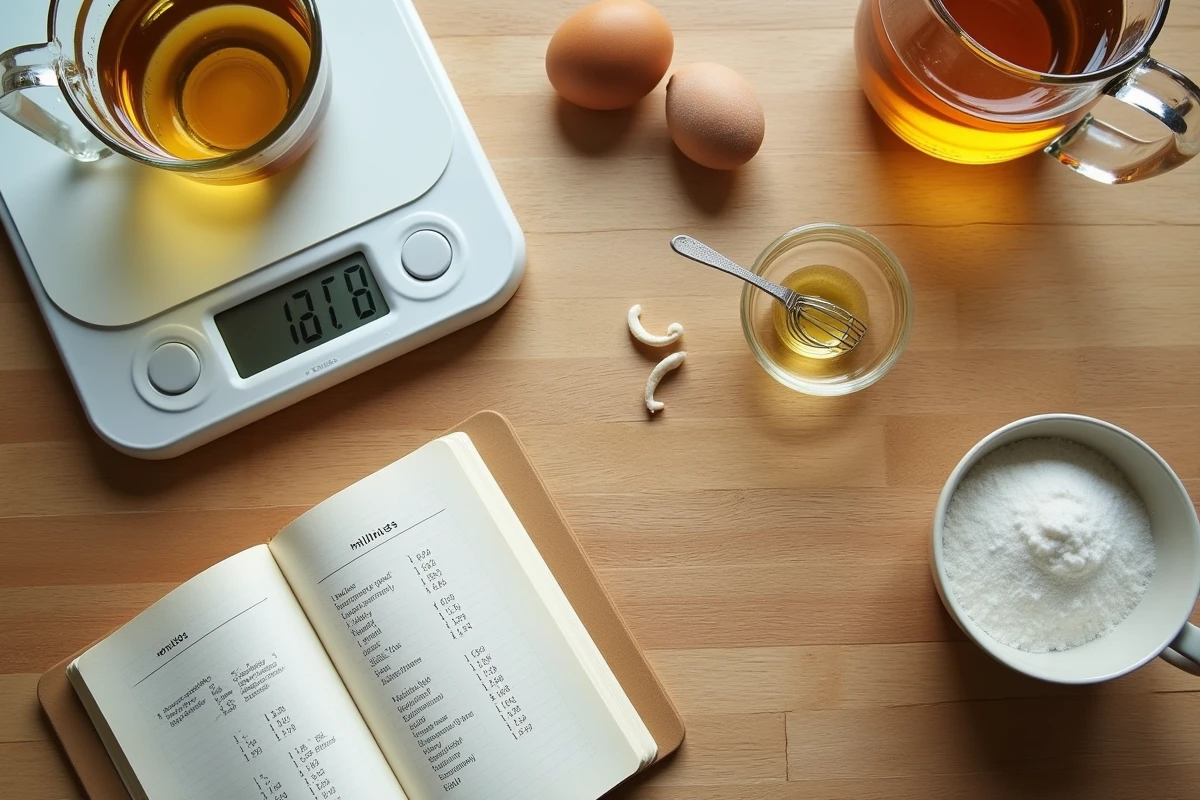
French recipes rarely express volumes in whole liters. The common unit is the centiliter, sometimes the milliliter. One liter contains one hundred centiliters, and this scale corresponds better to the quantities handled daily.
Converting grams to centiliters rather than liters avoids dealing with decimals. For water, the correspondence is simple: one gram equals one milliliter, so one hundred grams equals ten centiliters. For any other ingredient, density remains the necessary step.
Check the Conversion Before Multiplying
A tip rarely mentioned in cooking guides is to test the conversion on a small quantity before preparing the full recipe. Weighing the content of a tablespoon or a small measuring cup with a scale, then comparing it to the displayed volume, allows you to check if the theoretical density corresponds to the reality of the ingredient used.
This verification is particularly useful for artisanal flours or imported powders, whose moisture content and grain size differ from one brand to another.
Quick Method to Convert Without a Scale
When no scale is available, everyday containers serve as volume references. However, you need to know their actual capacity and not confuse volume with weight.
- A level tablespoon contains about fifteen milliliters of liquid. For flour or sugar, the weight corresponding to this volume differs.
- A standard table glass generally holds around twenty centiliters. This reference works well for aqueous liquids, much less so for powders.
- An empty yogurt pot, often used as a measure in baking, has a capacity that varies by brand. Checking it once with water and a scale is enough to use it as a reliable benchmark.
Always using the same container for the same recipe ensures reproducibility, even if the conversion to grams is not perfectly accurate. The consistency of the measurement matters as much as absolute precision.
Converting grams to liters in cooking boils down to a single variable: the density of the ingredient. As long as this data is known or verified, transitioning from one unit to another remains a simple arithmetic operation. The most useful reflex to acquire is not to memorize tables but to always ask which ingredient you are converting before reading an equivalence.