Standard plywood, even when treated, often gives way under humidity and temperature variations, while some lesser-known woods display a much higher resistance to intensive use. The most expensive wood species is not always the most durable, and some common installation methods accelerate the degradation of floors.
Manufacturers sometimes prioritize ease of installation over longevity, creating a gap between the commercial promise and the reality on the ground. Technical choices and substrate preparation directly condition the robustness and safety of the installed floor.
Choosing the right wood: overview of wood species suitable for trailer flooring
The choice of wood is at the heart of success. Resistance, stability, endurance: each species stands out by its response to humidity, temperature variations, and heavy loads. Marine plywood remains the reference, thanks to its cross-laminated layers glued under high pressure: it holds up well in terms of stability and humidity resistance. Favored in boating, this material brilliantly adapts to the demands of trailers.
Another option is film-faced plywood. It is sometimes confused with okoume, but it is distinguished by a protective phenolic film: it limits water absorption and simplifies maintenance, two advantages for those who regularly use their trailer. Some opt for solid wood, with oak or beech at the forefront. This solid choice weighs on the balance: it strengthens the structure, but its weight and the need for precise adaptation to the trailer require careful consideration. Panels made of okoume plywood, sourced from the tropics, are appealing for their lightness and natural resistance to humidity; however, care must be taken to properly treat the edges to counteract infiltration.
Here are the options to know when choosing a suitable wood species:
- Marine plywood: designed to resist water and endure against aggressions.
- Film-faced plywood: ideal for maintenance and safety thanks to its non-slip properties.
- Solid oak: provides robustness but requires consideration of the additional weight.
The plywood panel used to create a marine floor for Brico Dépôt trailer must combine durability and ease of installation. Aim for a thickness suited to the load, choose a certified water-resistant species, and opt for a finish designed to facilitate maintenance. Marine plywood, protected by effective treatments, remains a reliable investment for the sustainable outfitting of your trailer.
What criteria to prioritize for a truly solid and durable floor?
For a marine trailer floor that lasts through the years, several key criteria come into play. The thickness of the panel is paramount: it must precisely match the weight being transported. Too thin, the floor bends; too thick, the trailer becomes unnecessarily heavy. Here, coherence with the payload serves as a compass.
Another point of vigilance is humidity resistance. Marine plywood, designed to withstand water, prevents the wood from delaminating and mold from settling in. Phenolic glues and water-repellent treatments, signatures of marine plywood, protect the material year after year. Look for panel certification: it attests to manufacturing suited for humid conditions.
Fastening is crucial. A robust floor is useless without reliable anchoring: stainless steel screws, regular distribution, continuous support on the trailer cross members. Poor weight distribution or sparse anchoring points promote deformation and shorten the lifespan of the floor.
On the budget side, seek a coherent quality-price ratio: select a panel whose composition and density match the intended use. Marine plywood designed for demanding contexts protects the load and ensures the reliability of the trailer without breaking the bank.

Key steps and tips for a successful installation of your marine floor
Before starting, thoroughly inspect the structure of the trailer. A weakened chassis compromises the whole. Remove the old covering, hunt for residues, and clean thoroughly. Nothing replaces meticulous preparation.
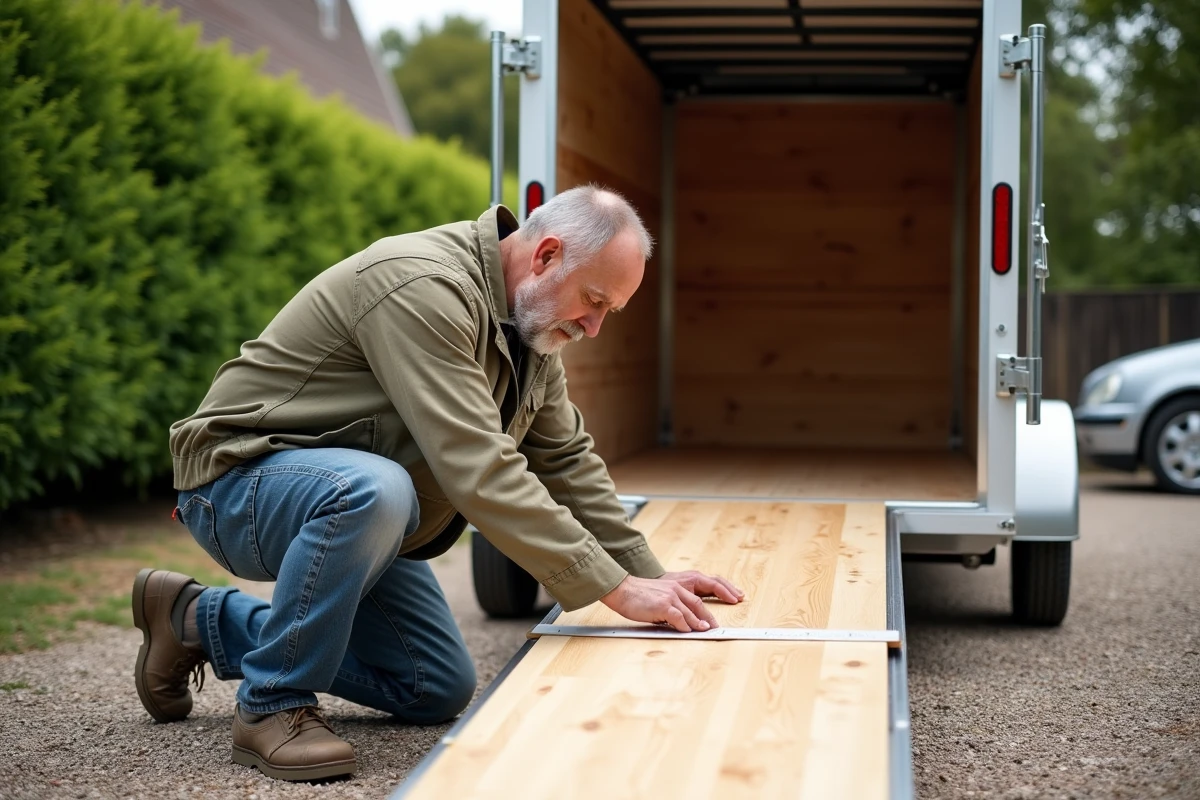
Measure the interior space accurately. A marine plywood panel often requires millimeter precision cutting. Mark your points, check the square, then use a circular saw for a clean cut. Before installation, review each edge: no play tolerated on the perimeter.
Protect the contact areas between wood and metal with a sealant barrier: anti-rust primer or bitumen tape as needed. This simple precaution prevents moisture from infiltrating and rotting the structure from below.
Fastening requires method and consistency. Space the anchoring points, favor stainless steel screws or through bolts: this will ensure uniform holding. Too many screws weaken the wood; too few leave the structure vulnerable. For the most stressed areas, or during an interior fitting, reinforce with distribution plates.
If your trailer endures heavy use, opt for non-slip film-faced plywood. Its surface reduces slipping risks and simplifies cleaning. In the end, inspect every detail: tighten the fastenings, check for leaks, and correct alignment. A well-installed floor gives you that silent feeling of solidity that accompanies you from the first kilometers.
Ultimately, a well-chosen and installed floor promises worry-free journeys, even in the rain or under load. Solidness is not a gamble, but the result of a series of concrete decisions aligned with your actual uses. The next time you load your trailer, you’ll know what truly makes the difference.