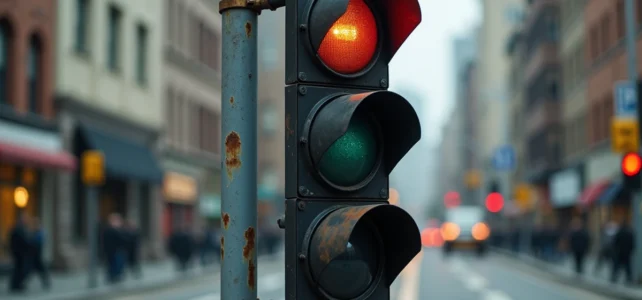
A blocked intersection with an orange flashing light, three lanes hesitating, honking horns: a traffic light failure turns an ordinary intersection into a tense zone. Knowing whom to pass the information to, and through which channel, can shorten the intervention time by several hours. However, it is essential to identify the right contact person, as it changes depending on the road in question.
Municipal or departmental road: the right contact makes all the difference
One might instinctively think of the town hall, and that is often the right lead, but not always. The traffic light manager depends on the classification of the road. On a municipal road, it is the road service of the municipality or intermunicipality that manages the maintenance of the lights. On a departmental road running through the same city, the responsibility may lie with the departmental council.
Before calling, a simple reflex: note the exact name of the street and the intersection. Some traffic lights have an identification plate on the pole, with a serial number or maintenance reference. This information speeds up the processing of the request on the technician’s side.
If one needs to understand the chain of responsibility and the options for reporting a malfunctioning traffic light, the details of the technical circuits help to make the right diagnosis even before picking up the phone.
Reporting by phone: town hall, technical service, and dedicated numbers
The most direct channel remains calling the town hall switchboard during business hours. Most municipalities have a technical service or road service available during the day. Explicitly asking for the service in charge of traffic signals avoids unnecessary transfers to urban planning or green spaces.
Outside of office hours, some cities have set up an on-call number for urgent road incidents. This number is rarely listed on the municipality’s website, but the town hall’s switchboard often mentions it on its voicemail.
Some local authorities have taken the logic further. In Puy-en-Velay, for example, a free hotline (0 800 463 879) was created as part of an energy performance contract with the CITEOS/EGEV group. This number covers public lighting and traffic lights: one call, and the report goes directly to the maintenance provider.
Applications and online forms: geolocated reporting
In recent years, many local authorities have shifted to multi-incident reporting applications that are no longer limited to potholes or lighting issues. These tools (web app or mobile app) allow users to geolocate the anomaly, add a photo, and receive email updates on the processing of their report.
In Paris, the “Dans Ma Rue” app covers all districts and includes traffic lights in its reporting categories. Users can locate the intersection on the map, describe the problem, and the request is automatically routed to the competent service.
Montpellier Méditerranée Métropole offers a dedicated form for traffic lights on its e-services portal. The form requires specifying the intersection (two street names), the nature of the malfunction, and allows users to attach a photo. A tracking number is assigned to monitor the progress of the request.
What these tools concretely change
The main benefit is not the simplicity of submission, but the traceability of the report. Unlike a phone call for which there is no record, the form or app generates a timestamped ticket. In case of follow-up or an accident at the concerned intersection, this ticket proves that the report was made at a specific date and time.
Responses vary on this point: some municipalities acknowledge receipt and update the status, while others leave the ticket without visible follow-up for several days. The tool does not guarantee the speed of intervention, but it ensures that there is written proof.
Traffic light failure and right of way: the right reflexes at the intersection
When faced with a dark or orange flashing light, the question of reporting comes after immediate safety. The highway code is clear: in the absence of a functioning light, the right of way to the right applies, unless a complementary traffic sign (stop, yield) is installed at the intersection.
This sign exists specifically to address failures. Before crossing the intersection, one must check if there is one, often placed under the light or on an adjacent pole. If there is nothing, the right of way to the right applies while reducing speed.
- Light off without sign: strict right of way to the right, slow down significantly when approaching
- Orange flashing light: increased caution, right of way to the right also applies unless otherwise indicated
- Light off with stop or yield sign: respect the sign as if the light did not exist
Once the intersection has been safely crossed, one can stop a few meters further to make the report. Note the exact address, the behavior of the light (off, flashing, stuck on a color), and, if possible, take a photo.
Information to transmit to expedite intervention
Whether reporting by phone, an online form, or an app, technicians need the same elements to intervene quickly:
- The exact address of the intersection, ideally the two street names forming the intersection
- The type of malfunction observed: light completely off, stuck on a color, continuously flashing
- The number of lights involved: a single pole or the entire intersection
- The presence or absence of a complementary traffic sign
- The time of the observation, especially if the malfunction seems intermittent
A precise report avoids back-and-forth between the receiving service and the maintenance team. At intersections equipped with connected regulation systems, the manager can sometimes diagnose the malfunction remotely even before sending a technician on-site.
The repair time depends on the severity of the malfunction and the danger of the intersection. A light on a busy road will be prioritized. For secondary intersections, the intervention may take longer, hence the importance of reporting without delay, even if one thinks someone else has already done it.